
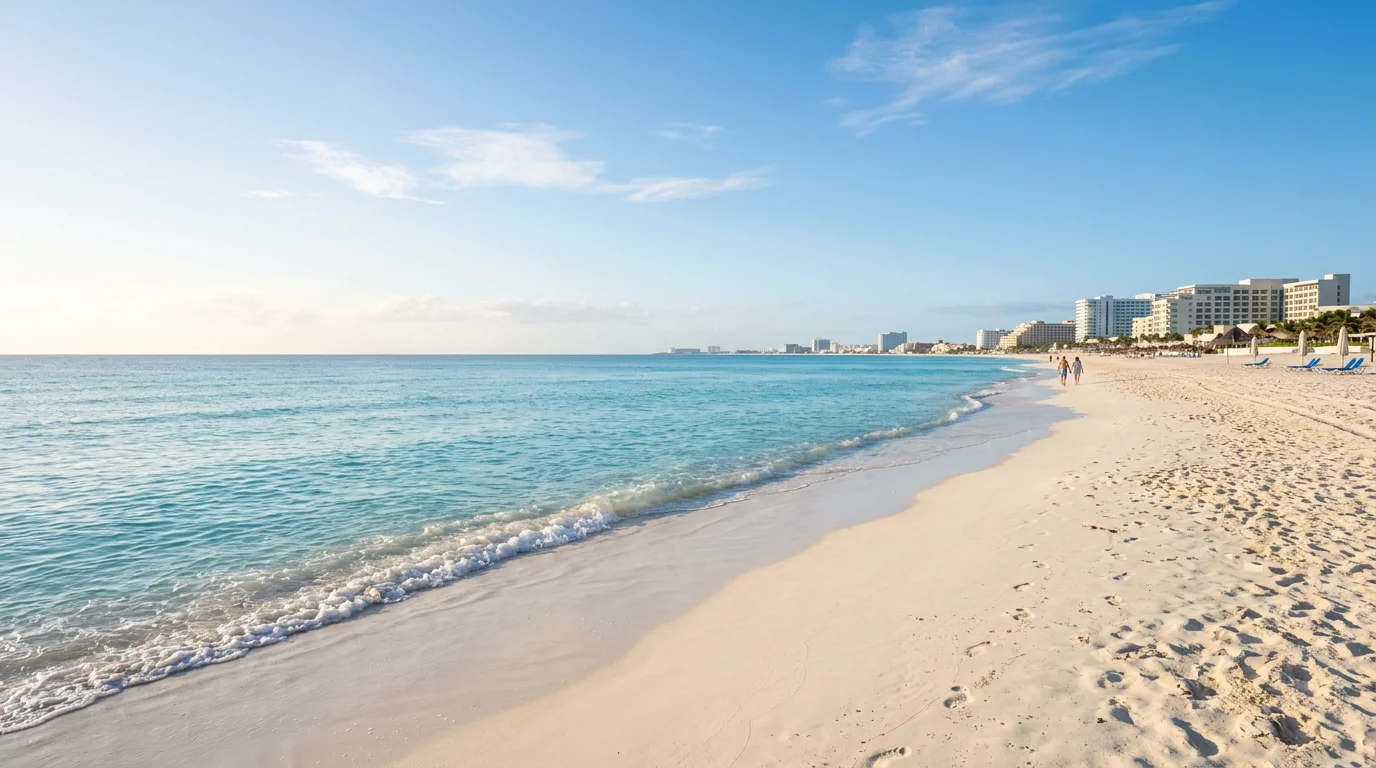
Best Time to Visit Cancun: Every Month Ranked for Weather, Crowds & Price
The best time to visit Cancun is December through February. You get dry, sunny weather, temperatures that stay comfortable rather than punishing, and — crucially — you avoid the Spring Break surge that makes March and April feel like a different destination entirely. If your only window is March or April, go early March before U.S. colleges break. If budget is the priority, late November and early May are the two months that most guides underrate.
Most competitors lead with “December to April” as a single block and leave it there. That framing is accurate but not useful. A family traveling in late December faces sold-out resorts and holiday pricing. A couple going in early January finds the same weather at 20–30% lower nightly rates. The month within the season matters as much as the season itself.
You can read our article to learn how to choose the best timing to travel → Best Time to Travel, By Goal, Season & Destination.
Table of Contents
Best Time to Visit Cancun: Season-by-Season Breakdown
Cancun’s year divides into three practical windows: a dry peak season (December–April), a hot and wet low season (May–October), and a brief shoulder window on each end. Each serves a different traveler profile.
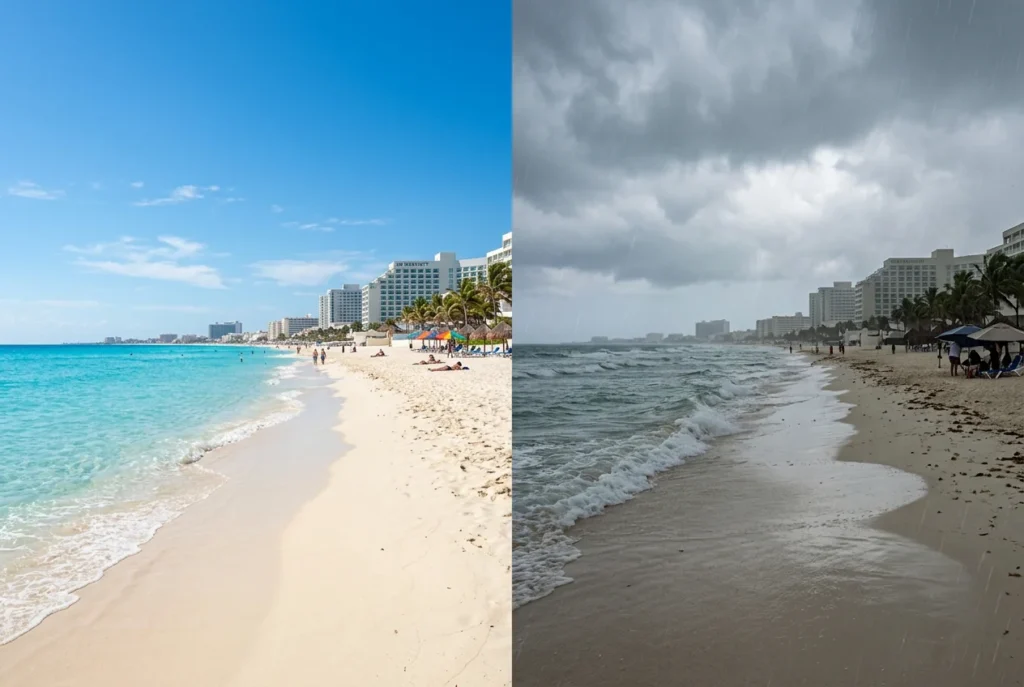
I visited in late January 2025 and found the Hotel Zone noticeably quieter than early December, with comparable weather and meaningfully lower rates. The beach at Playa Delfines was nearly empty midweek, and I booked a mid-range boutique hotel for $110 per night — about 35% less than what the same room cost during the Christmas holidays.
| Traveler Profile | Best Season | Budget Level | Top Priority |
|---|---|---|---|
| Couples / Honeymoons | January–February | Mid to Luxury | Weather + relative quiet |
| Families with school-age kids | Late November or early January | Mid to Luxury | Avoid Spring Break crowds |
| Spring Breakers | March–April | Budget to Mid | Nightlife, beach parties |
| Budget backpackers | May or late October | Budget | Low prices, manageable weather |
| Wildlife / Eco travelers | June–September | Budget to Mid | Whale sharks, sea turtle nesting |
| Luxury / Spa travelers | December–January | Luxury | Peak comfort, premium service |
The dry season delivers the most reliable beach days, but it is not uniformly good. Spring Break (mid-March through mid-April) brings the highest hotel rates of the year and the densest crowds in the Hotel Zone. Travelers who romanticize the low season should know that June through October carries genuine storm risk — not just afternoon showers.
Cancun Weather by Month
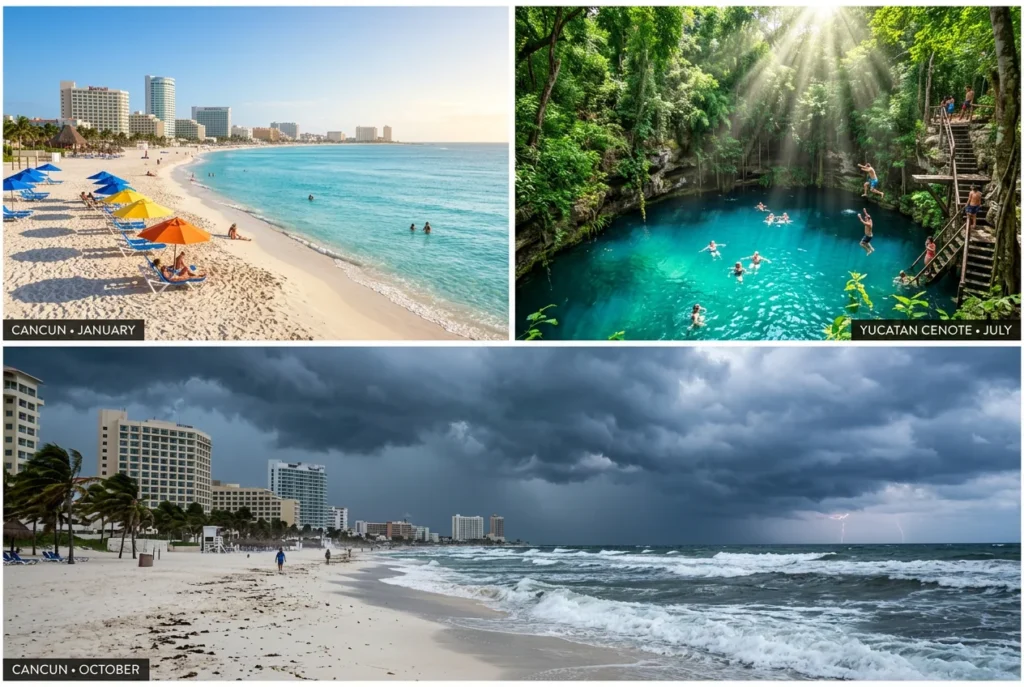
| Month | Avg Temp °C / °F | Rainfall | Crowd Level | Price Tier | Best For |
|---|---|---|---|---|---|
| January | 22–28°C / 72–82°F | Very low | High | High | Couples, beach relaxation |
| February | 22–28°C / 72–82°F | Very low | Moderate–High | High | Snorkeling, Isla Mujeres day trips |
| March | 24–30°C / 75–86°F | Low | Very High | Peak | Spring Break, nightlife |
| April | 25–31°C / 77–88°F | Low–Moderate | Very High | Peak | Ruins visits (early month only) |
| May | 26–32°C / 79–90°F | Moderate | Low | Low–Mid | Budget travel, cenotes |
| June | 27–33°C / 81–91°F | High | Low | Low | Whale shark season starts |
| July | 27–33°C / 81–91°F | High | Low–Moderate | Low | Whale sharks, sea turtle nesting |
| August | 27–33°C / 81–91°F | High | Moderate | Low–Mid | Whale sharks (peak), Xcaret |
| September | 26–31°C / 79–88°F | Very High | Very Low | Lowest | Budget only — storm risk high |
| October | 25–30°C / 77–86°F | High | Low | Low | Late whale sharks, cenotes |
| November | 23–29°C / 73–84°F | Low–Moderate | Low–Moderate | Mid | Best value month — improving weather, low prices, cultural events. |
| December | 22–28°C / 72–82°F | Very low | High | High–Peak | Dry season begins, holidays |
Sargassum note: Seaweed accumulation on Hotel Zone beaches is most likely May through October. It varies year to year and beach to beach — Playa del Carmen and the southern Hotel Zone tend to see heavier deposits than the northern stretches near Punta Cancun.
Is Cancun Better in December or January?
Quick Answer: January edges out December for most travelers. Weather is identical — dry, 22–28°C (72–82°F), minimal rain — but post-holiday pricing drops noticeably after the first week of January. December holiday weeks (Christmas through New Year’s) are the most expensive and crowded days of the entire year.

December is genuinely excellent weather — no argument there. The dry season kicks in reliably, and the first two weeks of December before the holiday rush are actually one of the quietest and best-value periods in the entire calendar. If you can travel December 1–18, you get dry-season conditions at shoulder-season prices.
The problem is the window from roughly December 20 through January 3. Resorts fill to capacity, nightly rates at mid-range Hotel Zone properties can double, and the airport at Cancun International (CUN) becomes one of the more chaotic transfer experiences in the Caribbean. Families with flexible school schedules should target the first two weeks of January specifically — crowds thin fast after New Year’s.
January as a whole is the single most consistent month in Cancun’s calendar. Temperatures hold steady, rain is rare, and the post-holiday lull means better availability and negotiable rates at boutique properties outside the all-inclusive corridor. For couples, it is the clearest recommendation on the calendar.
Travelers visiting in late January consistently find the Hotel Zone noticeably quieter than early December, with comparable weather and meaningfully lower rates.
When Is Hurricane Season in Cancun?
Quick Answer: Hurricane season in Cancun runs June 1 through November 30, with the highest risk concentrated in September and October. August also carries elevated risk. June and July see tropical weather but storms are less frequent — those months are viable for budget travelers who monitor forecasts and book refundable rates.
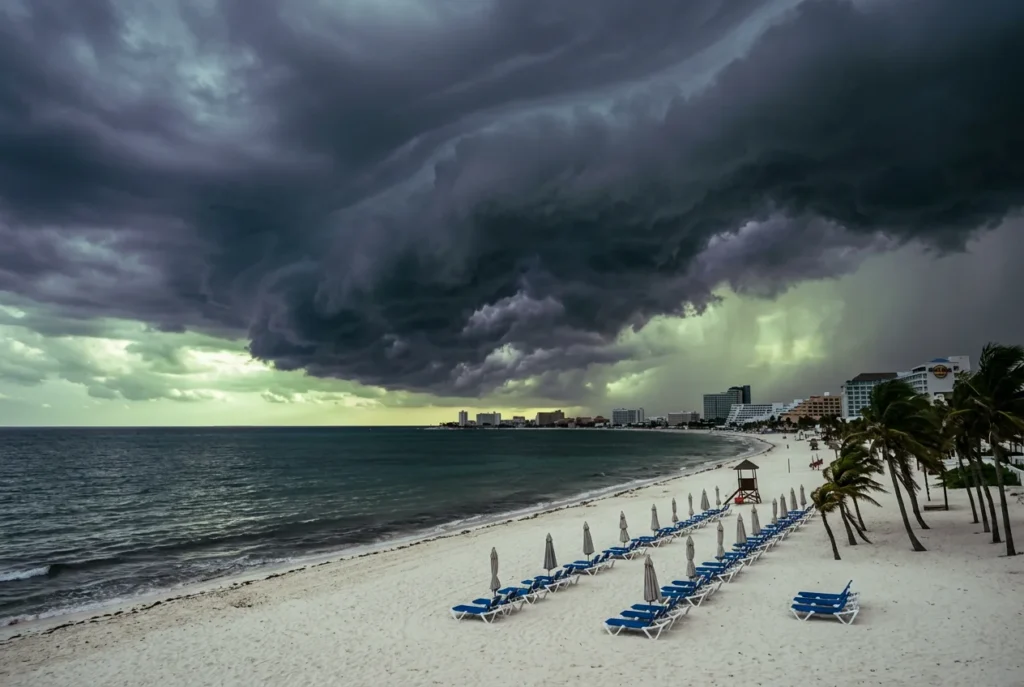
When I booked a whale shark tour in July 2024, I was nervous about the weather. The morning of the tour dawned clear and calm — we saw seven whale sharks by 10 a.m. and returned to port just as the afternoon clouds rolled in. That pattern held for most of my week: morning sun, brief afternoon showers, then clearing skies by dinner.
The Atlantic hurricane season is a real planning factor, not just a boilerplate warning. September is statistically the most active month, and Cancun’s position on the northeastern tip of the Yucatán Peninsula puts it in the direct path of storms tracking through the Caribbean. October follows closely. Both months offer the lowest prices of the year — but that discount exists because the risk is genuine.
June and July are a different calculation. Tropical storms are possible, but major hurricane strikes are less frequent in those months than in September–October. The bigger daily reality in June and July is afternoon rain — typically 1–2 hours of heavy showers that clear by evening. Morning beach time is usually unaffected. This is why whale shark season (June–September) remains a practical draw despite the rain: tours depart early, and weather windows cooperate more often than not.
If you are set on traveling during hurricane season, book fully refundable accommodations, purchase travel insurance that covers storm cancellations, and watch [EXTERNAL LINK: National Hurricane Center forecasts → National Oceanic and Atmospheric Administration (NOAA)]. Avoid locking in non-refundable packages for September or October regardless of the price.
What Is the Cheapest Time to Visit Cancun?
Quick Answer: September is the cheapest month to visit Cancun, with hotel rates at their annual low. October and May are the next most affordable. The sweet spot for budget travelers who still want reasonable weather is November — prices remain low, rain drops off sharply, and the dry season hasn’t yet pushed rates back up.
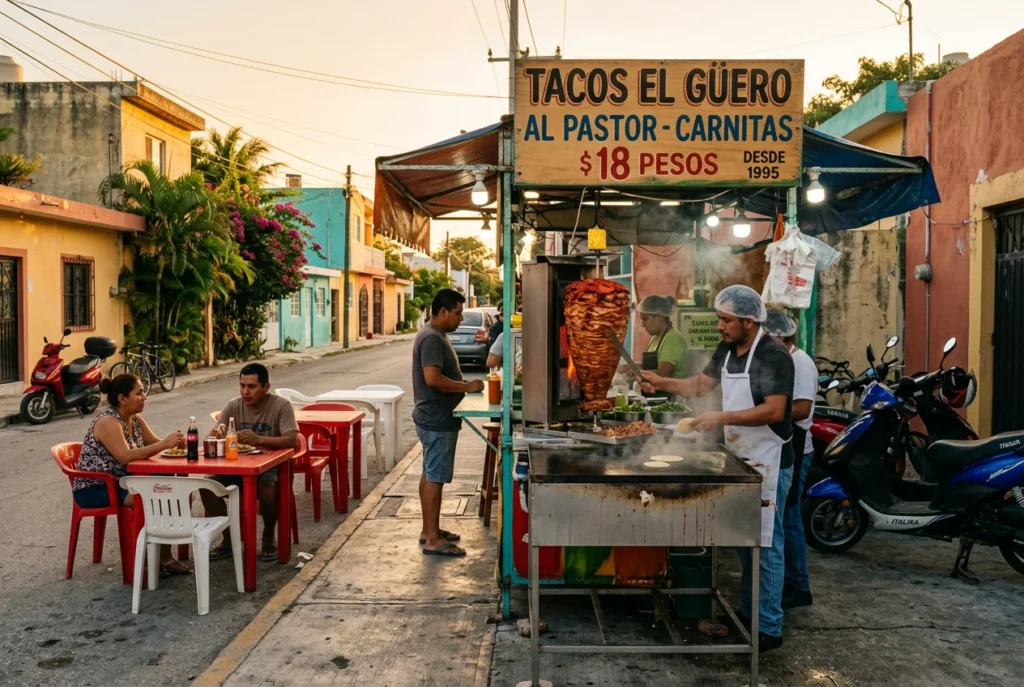
September prices can run 50–60% below peak-season rates at the same properties. That gap is real and it attracts a specific type of traveler — one who monitors weather apps daily, books refundable rooms, and accepts that a trip might get cut short. For that traveler, September works. For most people, it does not.
May is the underrated budget month. The dry season has just ended, so early May still sees mostly dry mornings. Humidity rises, afternoon showers become more frequent as the month progresses, and sargassum starts appearing on beaches — but hotel rates are low and the crowds are gone. Cenote swimming is excellent in May because the jungle is green and water levels are high.
November deserves more attention than it gets. By mid-November, the hurricane risk has dropped to near zero, rain frequency falls sharply, and the dry season conditions begin reasserting themselves — but peak-season pricing hasn’t kicked in yet. A traveler arriving in Cancun on November 15 gets weather close to January quality at prices closer to October. That window closes fast as December approaches.
Getting There & Around
Quick Answer: Cancun International Airport (CUN) is the main entry point. The R-1 bus runs the Hotel Zone for 12–15 pesos. Pre-booked airport transfers cost $15–25 USD per person. Avoid unmarked taxis at arrivals.
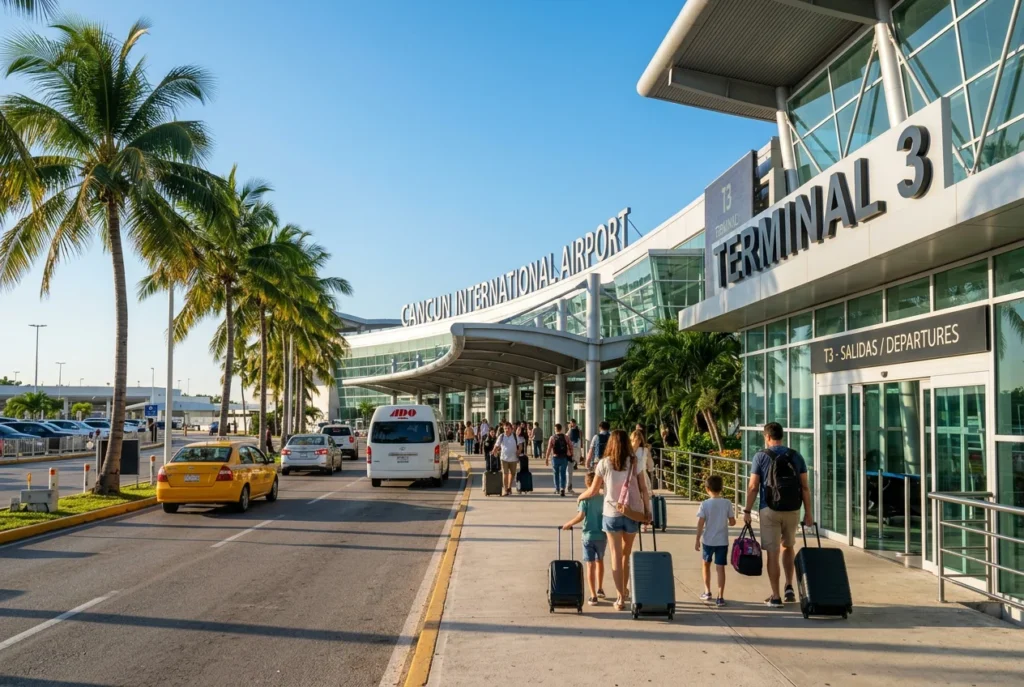
Flying in: Cancun International Airport (CUN) is the entry point for the vast majority of international visitors. Direct flights connect from major U.S., Canadian, and European hubs year-round. January and February see the highest airfare from North America — book 6–8 weeks ahead for those months. September and October offer the lowest fares, sometimes dramatically so.
Airport transfers: The Hotel Zone (Zona Hotelera) is roughly 20 kilometers from the airport. Licensed shuttle services and pre-booked transfers run $15–25 USD per person. Avoid unmarked taxis at arrivals — use the official transport desks inside the terminal. Uber operates from CUN but cannot legally pick up at the arrivals level; arrange pickup at departures or use the official services.
Getting around: The R-1 bus runs the length of the Hotel Zone for around 12–15 pesos and is reliable for most daytime movement between resorts, malls, and the ferry dock to Isla Mujeres. For day trips to Chichen Itza, Tulum, or Playa del Carmen, rental cars or organized tours are the practical options. Driving in the Hotel Zone itself is inefficient given traffic and parking.
Where to Stay
Quick Answer: Budget travelers should book Hostel Mundo Joven in downtown Cancun ($20/night). Mid-range options in the southern Hotel Zone run $80–150/night. Luxury all-inclusives in the northern Hotel Zone require booking 3–6 months ahead for peak season.
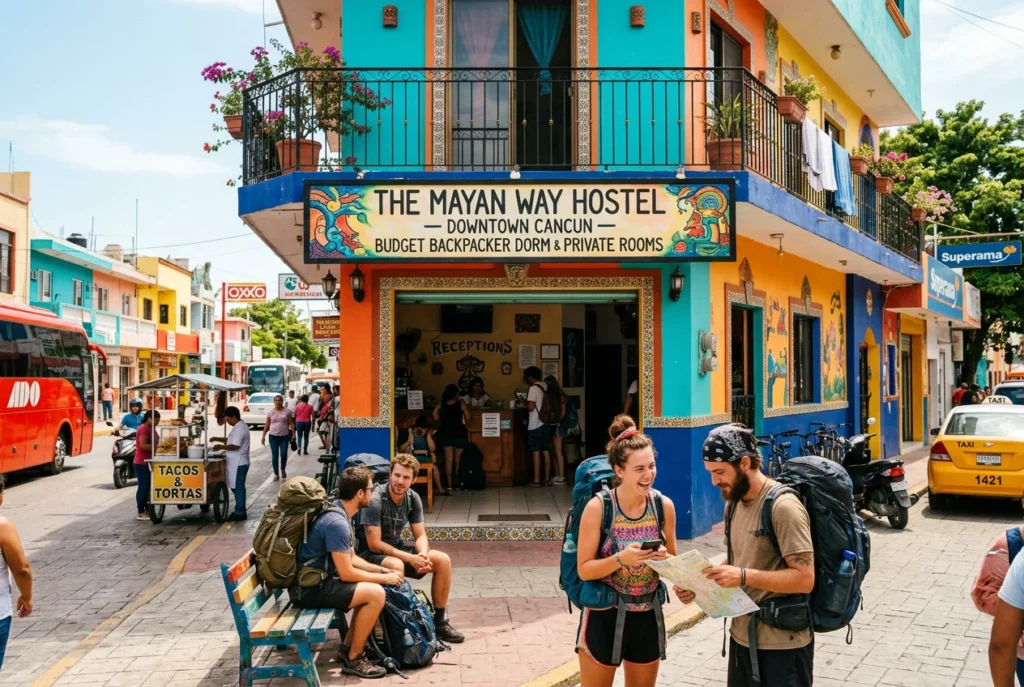
I stayed at Hostel Mundo Joven in September 2023 and paid $18 per night for a private room. The location near the ADO bus terminal made day trips to Chichen Itza and Tulum effortless, and the rooftop terrace was a great spot to meet other travelers. For that price, the value was unbeatable.
Budget: Hostel Mundo Joven Cancun in downtown Cancun (El Centro) puts you near local restaurants and the ADO bus terminal for Yucatán day trips. Rates in low season can drop under $20 USD per night.
Mid-range: Boutique hotels along the southern Hotel Zone — away from the mega-resort corridor — offer better value than the all-inclusive giants without sacrificing beach access. Properties in this tier typically run $80–150 USD per night in shoulder season.
Luxury / All-inclusive: The northern Hotel Zone strip concentrates the large all-inclusive resorts. The Ritz-Carlton Cancun and Live Aqua Beach Resort are consistently cited for service quality. Book January and February dates at least 3 months ahead; December holiday weeks require 4–6 months lead time.
Practical note: All-inclusive pricing can actually be competitive in peak season when you factor in food and beverage costs. In low season, the value proposition weakens — you are paying for services you may not use when afternoon rain limits beach time.
Top Things to Do by Season
Quick Answer: December–February is best for beach days and snorkeling. March–April is for nightlife. June–September is whale shark season. November offers the best value with cultural events and improving weather.

December–February (Dry Season): This is the window for beach days without weather anxiety. Snorkeling at Isla Mujeres and the MUSA underwater museum is at its clearest — visibility is excellent in calm, dry-season seas. Day trips to Chichen Itza are manageable in the cooler temperatures; the site gets brutally hot by April. Cenote Ik Kil near Chichen Itza is worth combining with a ruins visit in January or February before crowds build.
March–April (Peak / Spring Break): Nightlife in the Hotel Zone is at full intensity. If that is your goal, March delivers it. Ruins visits to Tulum are better in early March before heat and crowds peak. Xcaret and Xel-Ha eco-parks are busiest but fully operational. Budget travelers should note that even budget options in the Hotel Zone are expensive in this window.
May–July (Early Low Season): Cenote swimming comes into its own — the jungle is lush, water is refreshing against the humidity, and crowds at popular cenotes near Playa del Carmen thin considerably. Whale shark tours operate from Isla Mujeres from June onward; the experience of snorkeling alongside whale sharks in open water is one of the most specific reasons to consider this otherwise challenging season.
August–October (Storm Season): Sea turtle nesting on Cancun-area beaches runs through October. Several conservation programs allow supervised nighttime nesting observations — a genuinely rare experience that requires no special equipment and costs little. This is also when Xcaret’s cultural programming peaks. September and October remain the months to avoid unless storm flexibility is built into your plans.
November (Shoulder): The Día de los Muertos celebrations in late October and early November extend into the Cancun area and are worth experiencing if you are already in the region. Local food markets and cultural events in El Centro are active and accessible without tour-group pricing.
Season Comparison Table
Quick Answer: December–February offers the best weather but highest prices. May–August balances affordability with activities like whale sharks. November is the best value month — Cancun shoulder season at its finest.
| Season | Weather | Crowds | Price | Best For |
|---|---|---|---|---|
| Dec–Feb (Dry Peak) | Sunny, 22–29°C, very low rain | High (Holiday weeks: very high) | High | Couples, families, beach focus |
| Mar–Apr (Spring Peak) | Hot, sunny, low rain | Very High | Peak | Nightlife, Spring Break |
| May–Jun (Early Low) | Hot, humid, afternoon showers | Low | Low–Mid | Budget travel, cenotes, whale sharks |
| Jul–Aug (Mid Low) | Hot, humid, frequent rain | Low–Moderate | Low | Whale sharks, eco-activities |
| Sep–Oct (Storm Season) | Unpredictable, storm risk | Very Low | Lowest | Budget only, flexible itineraries |
| Nov (Shoulder) | Transitional, improving — Cancun shoulder season at its best | Low–Moderate | Mid | Best value, cultural events |
Common Mistakes to Avoid
Quick Answer: Don’t book March without checking school calendars. Don’t assume dry season means no clouds. Don’t ignore sargassum when booking beachfront rooms. Don’t underestimate September’s storm risk. Don’t skip November — it’s the best value month.
Booking March without checking school calendars. U.S. and Canadian Spring Break does not fall on a single week — it spreads across 3–4 weeks from mid-March through mid-April depending on the institution. What looks like “late March availability” can still land you in peak crowd conditions.
Assuming the dry season means no clouds. December through April is reliably dry, but overcast mornings occur — especially in December and January. The weather is not tropical-postcard perfect every single day. It is, however, far more consistent than any other season.
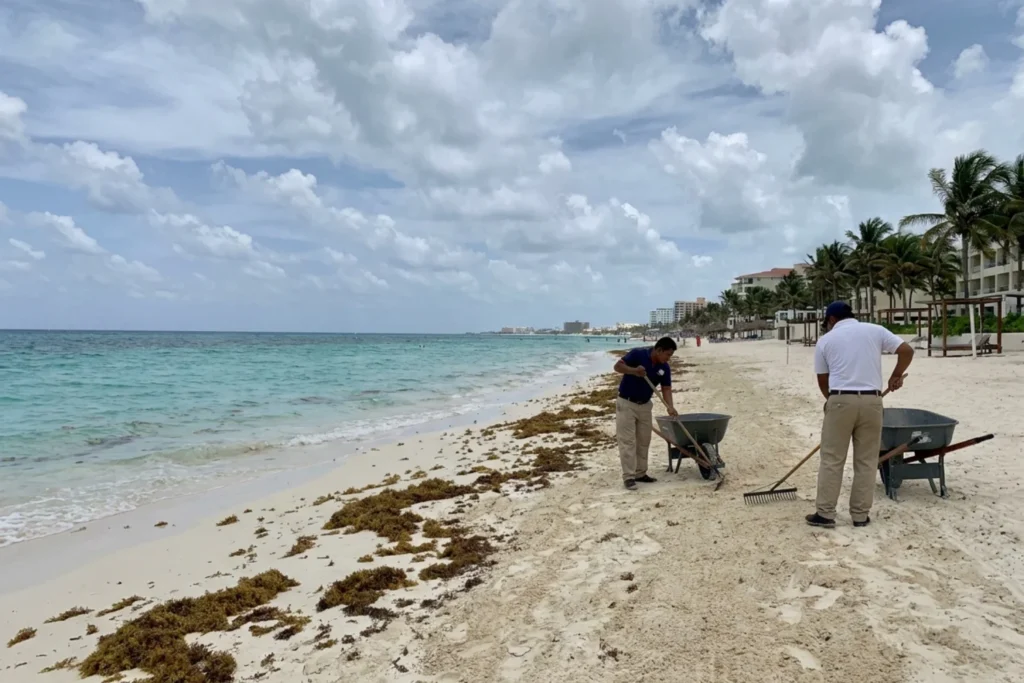
Ignoring sargassum when booking beachfront rooms. Seaweed accumulation is unpredictable and can affect the beach directly outside your resort window. Check recent reports for your specific property before booking a premium beachfront rate in May through October. Hotels clean beaches daily but cannot control volume.
Underestimating September. Travelers who book September based purely on price without understanding the storm risk sometimes find themselves with cancelled excursions, resort lockdowns, or early departures. The savings are real. So is the risk.
Skipping November. It is the most underused good-value month in Cancun’s calendar, and most guides barely mention it. Mid-to-late November offers dry-season-adjacent weather, low crowds, and mid-range pricing. If your dates are flexible and you are not committed to peak beach conditions, this window deserves serious consideration.
Conclusion
December through February is the clearest recommendation for most travelers — reliable weather, full activity options, and a manageable crowd level outside the holiday weeks. January specifically hits the best balance of all three factors. If budget is the constraint, aim for November or early May. If whale sharks are the goal, plan for July or August and accept the rain as part of the deal.
Cancun rewards travelers who match their timing to their actual priorities rather than chasing a single “best” month. Use the tables above to identify your window, book refundable options if you are traveling May through October, and lock in accommodations at least 8–10 weeks ahead for any December through April travel.

Explore more on ChillTraveling:
- Best Time to Travel in 2026: By Goal, Season & Destination → Read the article
- When Is the Best Time to Visit Hawaii — and Why It Actually Depends → Read the article
C. FAQ SECTION
Q: What is the single best month to visit Cancun for good weather without peak crowds?
A: January is the strongest single month. The dry season is fully established, temperatures run 22–28°C (72–82°F), rainfall is minimal, and the post-holiday drop in visitors after the first week makes the Hotel Zone noticeably quieter than December. It is also cheaper than March or April. For couples or travelers without school-schedule constraints, January is the clearest choice on the calendar.
Q: Is November a good time to visit Cancun?
A: Yes — and it is consistently underrated. By mid-November, hurricane risk has dropped to near zero, rainfall frequency falls sharply, and dry-season conditions begin returning. Prices stay closer to low-season rates than peak-season rates. Travelers who visit in late November often find beach conditions nearly as good as January at meaningfully lower cost. It is the best value month for flexible travelers.
Q: When does whale shark season run in Cancun, and is it worth the rain risk?
A: Whale shark season runs June through September, with July and August being peak months for sightings near Isla Mujeres. Tours depart early morning before afternoon rain typically arrives, so weather disruption is less frequent than it sounds. The experience is specific enough — snorkeling alongside the world’s largest fish in open Caribbean water — that many eco-focused travelers book specifically around this window despite the low-season conditions.
Q: How bad is sargassum seaweed in Cancun, and which months are worst?
A: Sargassum accumulation is most likely May through October, with June through August typically seeing the heaviest deposits. It varies significantly by beach and year — the northern Hotel Zone generally fares better than southern stretches. Hotels clean beaches daily, but heavy influx can make swimming unpleasant for days at a time. Check property-specific recent reviews before booking a premium beachfront room in those months.
Q: What is the cheapest month to fly to Cancun?
A: September consistently offers the lowest airfares and hotel rates of the year — sometimes 50–60% below January prices for the same properties. October is the next most affordable. For travelers who want low prices without maximum storm risk, November offers a reasonable middle ground: rates are still well below peak, and the weather improves noticeably as the month progresses.
Q: Is Cancun worth visiting in May?
A: Early May can work well for budget-focused travelers. The first two weeks often see mostly dry mornings before the rainy season fully establishes itself. Humidity is rising, afternoon showers become more frequent as the month goes on, and sargassum starts appearing on beaches — but crowds are low and cenote swimming near Playa del Carmen is excellent. Avoid late May if consistent beach weather is the priority.
Q: How far in advance should I book Cancun hotels for peak season?
A: For January and February travel, book 6–8 weeks ahead minimum. For the December holiday window (December 20–January 3), 4–6 months is realistic for mid-range and luxury properties — the best rooms at popular all-inclusives sell out well before that. Spring Break dates in March and April also require early booking; availability tightens fast once U.S. school calendars publish break dates.
Q: Can families with young children visit Cancun during hurricane season?
A: Families with young children and limited schedule flexibility should avoid September and October. June and July are more viable — storm frequency is lower, whale shark tours offer a genuinely memorable family experience, and the afternoon rain pattern still allows morning beach time. Book fully refundable accommodations, purchase comprehensive travel insurance, and have a contingency plan if a tropical system develops during your stay.