Best Beaches in Florida — A Practical Coast-by-Coast Guide
The best beaches in Florida don’t all look the same, and most “top 10” lists flatten 1,350 miles of coastline into a single vibe. That’s a mistake. Clearwater Beach and Siesta Key dominate rankings because they photograph well, but they’re not automatically the right beach for your trip — especially if you hate circling a parking garage for 40 minutes in April.
Here’s what actually matters: the Gulf Coast is warmer, calmer, and shallower. The Atlantic side has better surf and cooler water in summer. The Panhandle has the whitest sand but the shortest swimming season. The Keys feel tropical but have almost no traditional sand beach. Once you know which coastline matches your priorities, the rest falls into place.
Let’s start with the question that shapes every Florida beach trip.
Table of Contents
Which Side of Florida Has the Best Beaches?
Quick Answer: The Gulf Coast wins for calm water, powdery sand, and family-friendly swimming. The Atlantic Coast is better for surfing, fishing, and a younger energy. Neither is universally “better” — it depends entirely on what you want from a beach day.
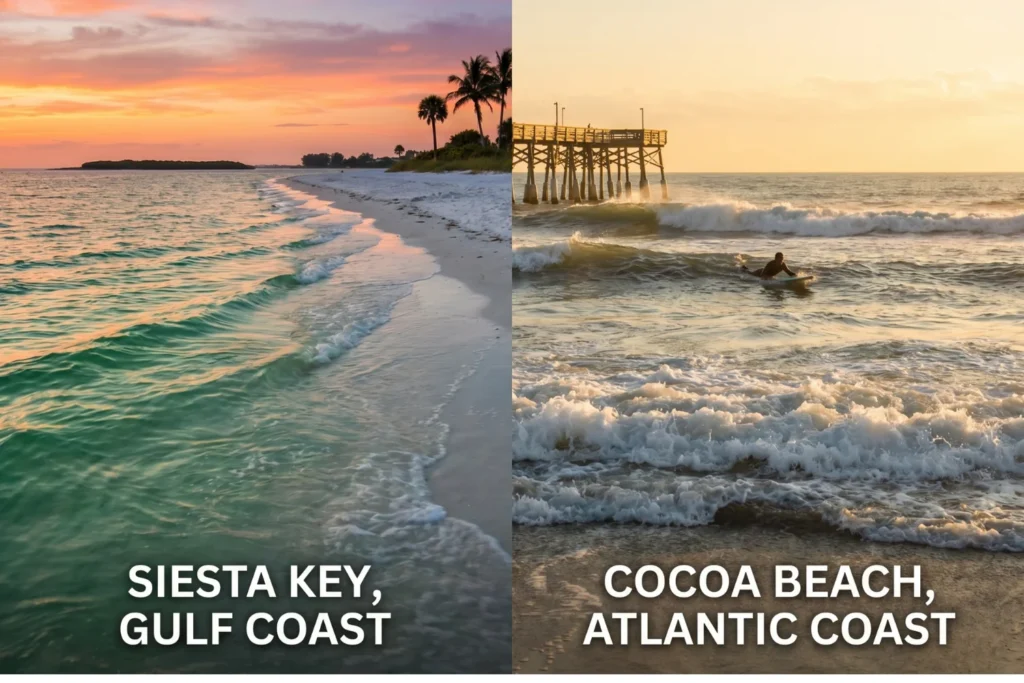
In March 2025, my friend Jenna from Chicago drove from Miami to Clearwater expecting “more of the same beach” and was stunned by the difference. She paid $28 in tolls and parking that day, but told me afterward it was the best $28 she spent all year. The Atlantic side had choppy blue-green waves and coarse tan sand. Two hours west, the Gulf delivered flat, warm, almost lake-like turquoise water over sand so fine it squeaked underfoot. Same state. Completely different experience.
Gulf Coast strengths:
- Calmer water (waves rarely exceed 1–2 feet)
- Finer, whiter sand — especially Siesta Key’s 99% quartz composition
- Warmer water temperatures year-round (averaging 75–85°F May through October)
- Better for young children, older swimmers, and paddleboarding
Atlantic Coast strengths:
- Consistent surf (particularly Cocoa Beach, Sebastian Inlet, Jacksonville Beach)
- Wider beaches in many areas (Daytona, St. Augustine)
- Cooler water in peak summer — a relief when Gulf temps hit 90°F
- More nightlife and walkable boardwalk culture (Fort Lauderdale, South Beach)
Panhandle (technically Gulf, but distinct):
- Whitest sand in the state — the quartz originates from Appalachian erosion
- Cooler water and shorter season (comfortable swimming June through September)
- Less developed in patches: Grayton Beach and Henderson Beach State Park feel uncrowded even in summer
Florida Keys:
- Limited traditional beach — most shorelines are rocky or narrow
- Best snorkeling and diving water clarity
- Bahia Honda State Park is the exception: a genuine sand beach with reef access
The biggest misconception? That South Beach represents Florida’s Atlantic coast. It doesn’t. North of Palm Beach, the coast becomes quieter, wider, and far less expensive.
Knowing which coast suits you narrows the decision — but within each coast, the family question changes everything.
What Is the Best Beach in Florida for Families?
Quick Answer: Clearwater Beach is the most practical choice for families with children under 10 — shallow water extends 50+ yards offshore, lifeguards patrol daily, and Clearwater Marine Aquarium is minutes away. For older kids, Destin offers more water-sport variety.
Every competitor article says “Clearwater is great for families” and moves on. Here’s what they don’t mention: Clearwater Beach’s parking situation during spring break is genuinely awful. The main garage fills by 10 AM. The beach itself is superb — gradual slope, minimal current, soft sand — but arriving without a parking plan means frustration.
Best family beaches ranked by child age:
- Toddlers (0–4): Siesta Key — the sand stays cool even at midday due to its quartz composition. No shells to step on. Very gradual entry.
- Young kids (5–10): Clearwater Beach — lifeguards, nearby restrooms, Pier 60 playground, dolphin-watching boats departing hourly.
- Tweens (10–14): Destin / Henderson Beach — calmer than Atlantic side but enough wave action for boogie boarding. Destin Harbor has fishing charters sized for families ($80–$120 per person for a half-day).
- Teens: Cocoa Beach (Atlantic) — surfboard rentals at $25/half-day, proximity to Kennedy Space Center, and a younger crowd.
Practical family logistics:
- State park beaches (Caladesi Island, Bahia Honda) charge $6–$8 per vehicle but have cleaner facilities and fewer vendors
- Renting a beach umbrella setup at Clearwater costs $40–$60/day — bringing your own saves real money over a week
- St. Augustine Beach has free parking south of the main access points and tide pools at low tide that fascinate kids for hours
One detail parents miss: Gulf beaches have minimal wave action, which means no natural “rinse cycle.” Kids stay sandy. Pack a jug of fresh water for the car ride home.
Timing your visit matters as much as choosing the right beach — and most guides oversimplify this.
What Is the Best Time to Visit Florida Beaches?
Quick Answer: The best time to visit Florida beaches is March through May for warm weather, manageable crowds, and no hurricane risk. September through early November offers lower prices and empty sand but carries a small hurricane-season gamble. Avoid June through August if you dislike afternoon thunderstorms and 90°F+ heat.
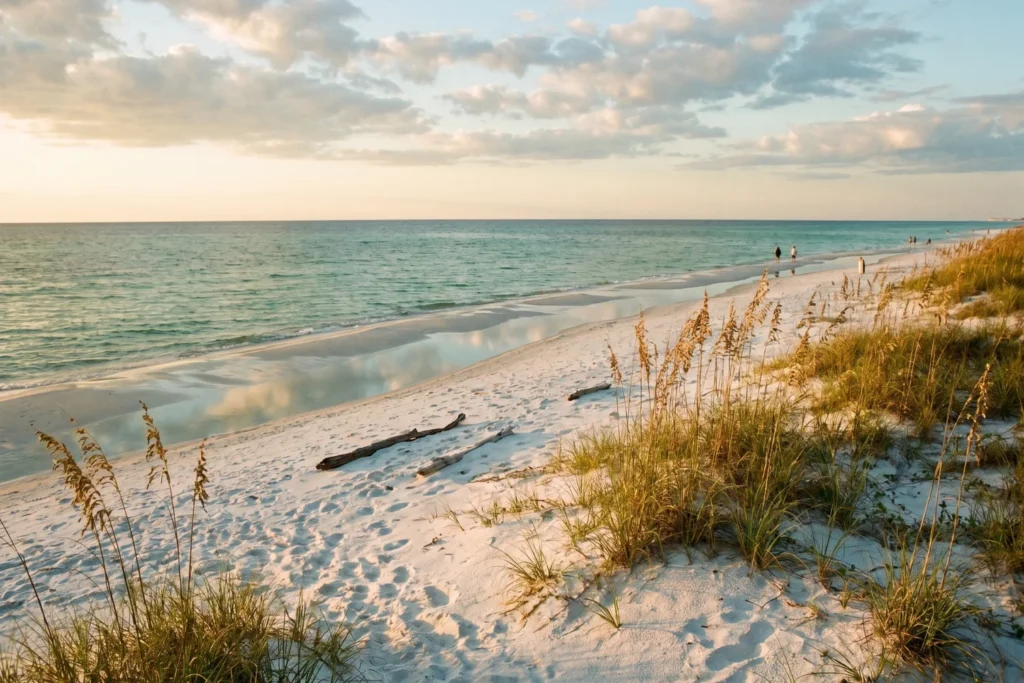
Here’s the thing most guides won’t say plainly: summer is actually the worst time to visit Florida beaches for comfort. Not the best. Daily thunderstorms roll in between 2–4 PM like clockwork from June through September. The air is thick. Sand surface temperatures can exceed 130°F at midday, making barefoot walking painful.
Season-by-season breakdown:
| Season | Pros | Cons | Crowd Level |
|---|---|---|---|
| Mar–May | Warm (78–85°F), low humidity, clear water | Spring break crowds (March), rising prices | High (March), Moderate (April–May) |
| Jun–Aug | Warmest water, longest days | Daily storms, extreme heat, hurricane season starts, red tide risk on Gulf | High |
| Sep–Nov | Cheapest rates, empty beaches, warm water | Hurricane risk through October, some businesses reduce hours | Low |
| Dec–Feb | Snowbird season, pleasant air temps (65–75°F) | Water too cold for many (60–70°F), Gulf wind chill | Moderate–High (holidays) |
Red tide caveat: Southwest Florida (Fort Myers Beach, Sanibel, Naples) occasionally experiences red tide blooms, mostly late summer through fall. Symptoms include respiratory irritation and dead fish on shore. Check the Florida Fish and Wildlife Conservation Commission’s red tide status map before booking. Florida red tide current conditions → Florida Fish and Wildlife Conservation Commission
The contrarian insight: September is genuinely underrated. Water temperatures remain in the low 80s. Hotel rates drop 30–50% from peak. The hurricane risk is real but manageable — modern forecasting gives 5+ days of warning. Travelers who visited Clearwater Beach in late September consistently report having 100 yards of sand to themselves on weekday mornings.
Now that timing is sorted, let’s talk about actually getting to these beaches — because Florida’s size surprises everyone.
Getting There & Getting Around
The biggest rookie error? Flying into Miami when your beach is on the Gulf Coast. Florida is 450 miles long. Choosing the wrong airport costs you half a day of driving.
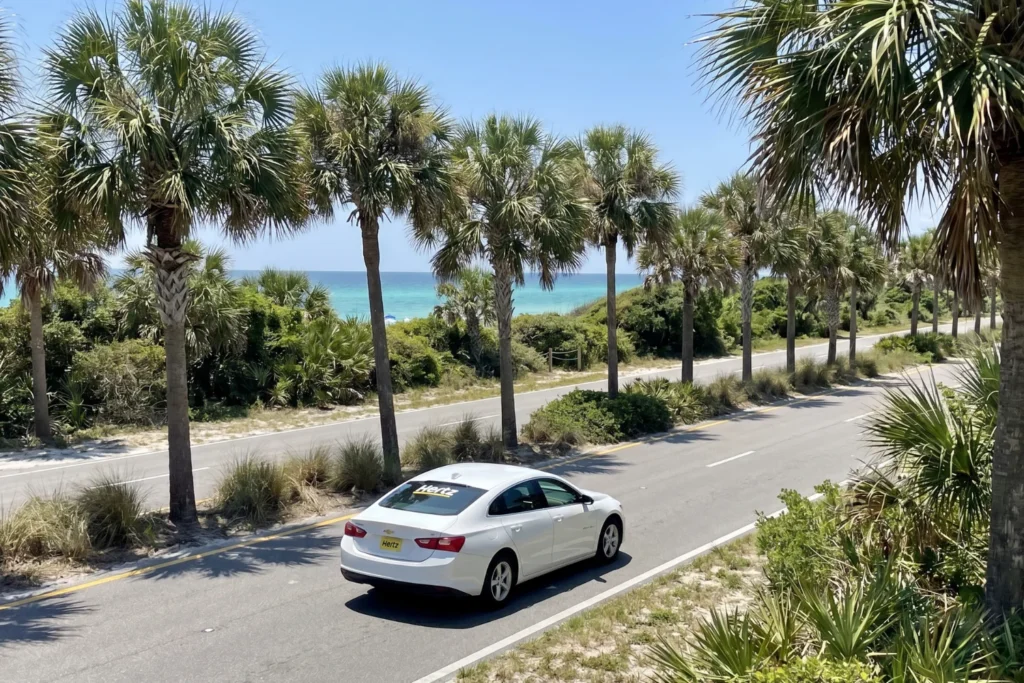
Airport-to-beach matching:
- Clearwater / St. Pete Beach / Siesta Key: Fly into Tampa (TPA) — 30–90 min drive depending on beach
- Destin / Panama City Beach / Panhandle: Fly into Destin-Fort Walton (VPS) or Panama City (ECP)
- South Beach / Fort Lauderdale: Fly into Fort Lauderdale (FLL) — cheaper than Miami (MIA) and 30 min closer to the beach
- Florida Keys / Bahia Honda: Fly into Miami or Key West (EYW) — Key West is tiny and expensive; Miami + 3-hour drive is usually cheaper
- St. Augustine Beach: Fly into Jacksonville (JAX) — 45 min south
Getting around:
- A rental car is essentially mandatory for Gulf Coast and Panhandle beaches. Public transit is unreliable outside Miami.
- In Miami/South Beach, skip the car entirely. Use the free Metromover downtown and rideshares to the beach.
- The Jolley Trolley runs along Clearwater Beach for $2.50/ride — useful for avoiding parking entirely if your hotel is on the route.
- Uber/Lyft work statewide but surge pricing near beaches on weekends can triple fares.
Parking realities:
- Clearwater Beach garage: $3/hour, $20 max. Full by 10 AM on weekends March–August.
- Siesta Key: free public lot fills by 9 AM on weekends; overflow street parking exists but residents complain.
- State parks (Caladesi Island, Henderson Beach): $6–$8/vehicle, rarely full on weekdays.
- South Beach metered parking: $4/hour. Enforcement is aggressive.
Apps to download before arrival:
- ParkMobile (beach parking meters statewide)
- VisitFlorida app (beach conditions and closures)
- MyRadar (afternoon storm tracking — essential June–September)
The beach you choose determines where you sleep — and the gap between “beachfront” and “beach-adjacent” pricing is enormous.
Where to Stay — Best Neighborhoods & Options
Most travelers overpay for beachfront hotels when a property one block inland costs 40% less with the same beach access. The sand is public in Florida. You don’t need to sleep on it to use it.
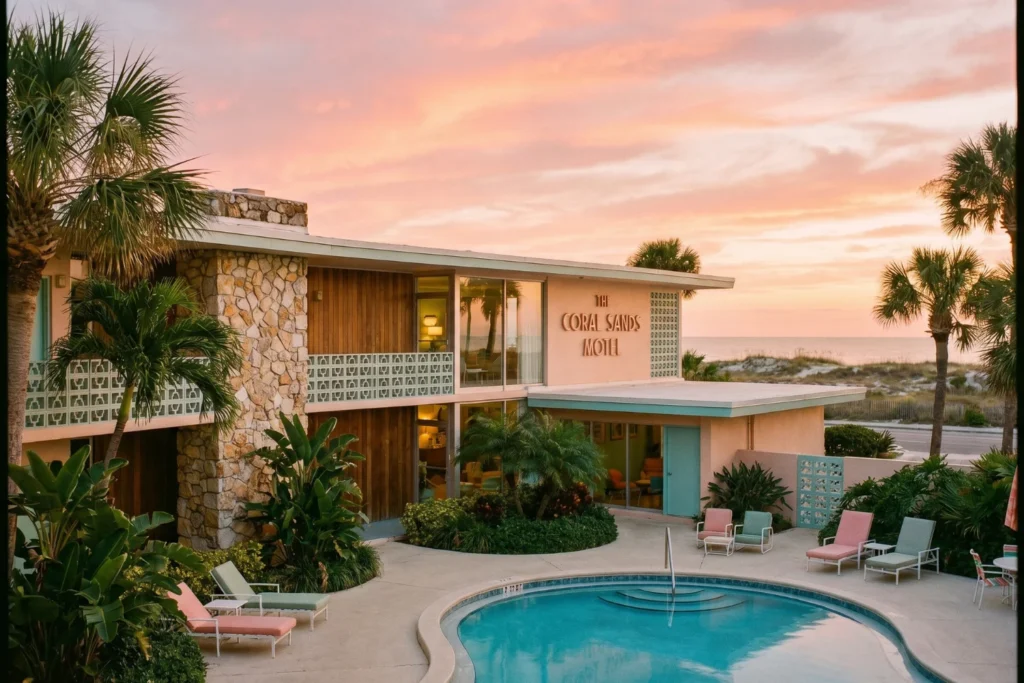
Neighborhood comparison:
| Area | Vibe | Price Range (per night) | Best For |
|---|---|---|---|
| Clearwater Beach | Busy resort strip, walkable | $180–$450 | Families, first-timers |
| Siesta Key Village | Laid-back, shops/restaurants nearby | $150–$350 | Couples, relaxed trips |
| Destin/Miramar Beach | Condo-heavy, commercialized | $120–$300 | Families, water sports |
| South Beach (Miami) | Loud, glamorous, nightlife | $250–$600+ | Couples, party-seekers |
| St. Augustine Beach | Historic charm, quieter | $100–$250 | Couples, history buffs |
| Bahia Honda / Lower Keys | Remote, nature-focused | $80–$200 (camping–cabins) | Nature lovers, snorkelers |
Budget tier recommendations:
Budget ($80–$150/night):
- Vacation rentals in Madeira Beach (near St. Pete) — full kitchens cut food costs
- Camping at Bahia Honda State Park ($36–$50/night for waterfront sites — book 11 months ahead)
- Motels along A1A north of Fort Lauderdale — dated but clean, steps from sand
Mid-range ($150–$300/night):
- Hyatt Regency Clearwater Beach — pool, Gulf views, walkable to Pier 60
- Holiday Inn Resort Panama City Beach — directly on sand, reasonable for the Panhandle
- Casa Marina, St. Augustine — historic property, quiet, 5-min walk to beach
Luxury ($300+/night):
- The Don CeSar (St. Pete Beach) — the iconic pink palace, full spa, beachfront
- Four Seasons Resort Palm Beach — Atlantic side, impeccable service
- Little Palm Island Resort (Lower Keys) — adults-only, boat-access only, truly remote
Honest tradeoff: Beachfront in Clearwater means nightly noise from bars until midnight and a parking nightmare. Staying at the south end of Sand Key (technically the next island) gives identical beach quality with half the chaos and free street parking.
Once your base is locked in, here’s what a beach trip to Florida actually costs — and the answer surprised me.
Budget & Cost of the Trip
A comfortable beach trip to Florida costs approximately $150–$250 per person per day for a mid-range traveler, including accommodation, food, parking, and one activity. That’s higher than most people budget because parking fees, beach rental gear, and restaurant prices near the shore inflate costs quickly.
Daily budget breakdown (per person, assuming double occupancy):
| Category | Budget | Mid-Range | Comfort/Luxury |
|---|---|---|---|
| Accommodation | $50–$75 | $100–$150 | $200–$400 |
| Food | $30–$45 | $50–$80 | $100–$150 |
| Transport/Parking | $15–$25 | $25–$40 | $40–$60 |
| Activities | $0–$20 | $30–$60 | $80–$200 |
| Daily Total | $95–$165 | $205–$330 | $420–$810 |
What costs more than expected:
- Beach umbrella + chair rentals: $40–$70/day at popular beaches (Clearwater, Destin)
- Parking at Clearwater Beach or South Beach: $20–$30/day
- Boat tours and water sports: snorkeling trips run $50–$80/person; jet ski rentals $80–$120/hour
- Beachfront dining: a casual seafood dinner for two with drinks easily hits $80–$120
Where to save money:
- Bring your own beach gear — a decent umbrella from Walmart costs $25, pays for itself in one day
- Eat lunch at the beach, dinner inland. A restaurant two blocks from the shore charges 30% less for the same fish
- Visit state park beaches ($6–$8 entry) instead of municipal beaches with expensive parking
- Grocery stores like Publix stock excellent subs ($8–$10) that beat most overpriced beachfront sandwich shops
Free beach options: Many Atlantic-side beaches (Jacksonville Beach, Cocoa Beach, Melbourne Beach) have free parking and no entry fees — a genuine budget advantage over the Gulf’s more famous names.
Now let’s talk about what to eat — because Florida beach towns have more culinary range than the typical fried-shrimp basket suggests.
Where to Eat & What to Eat
Skip the first restaurant you see on any beach boardwalk. It’s overpriced and microwaving frozen seafood. Florida’s coastal food scene is excellent — you just need to walk two blocks inland or know the local spots.
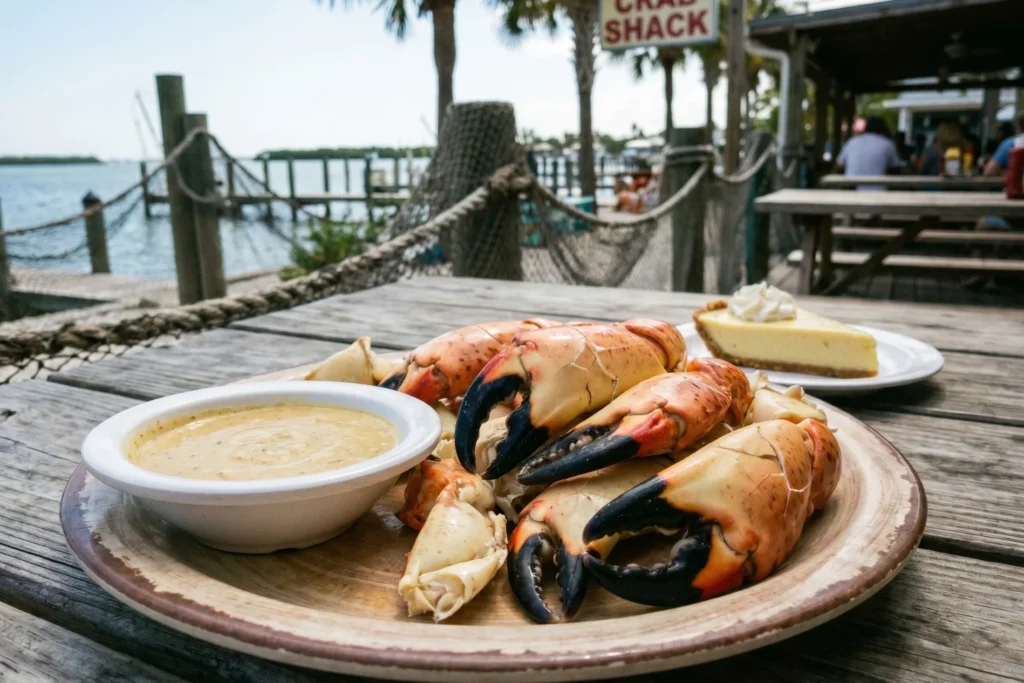
Dishes worth seeking out:
- Grouper sandwich — the definitive Florida beach food. Blackened or fried, served on a soft bun. Best versions use fresh-caught, never frozen.
- Stone crab claws (October–May only) — sweet, cold, dipped in mustard sauce. Expensive ($30–$50/lb) but unmissable during season.
- Smoked fish spread — a Gulf Coast specialty. Smoked mullet or mahi blended with cream cheese, served with crackers.
- Cuban sandwich — technically Tampa’s claim to fame. Pressed ham, pork, Swiss, pickles, mustard on Cuban bread.
- Key lime pie — in the Keys, insist on the traditional version: yellow (not green), tart, with a graham cracker crust.
Named recommendations:
- Frenchy’s Outpost (Clearwater): Grouper sandwich ($16) that locals swear by. Less crowded than the original Frenchy’s location.
- Destin Harbor boardwalk food stalls: Fried shrimp baskets ($12–$15), eaten watching fishing boats unload.
- Siesta Key Oyster Bar (SKOB): Casual, loud, affordable oysters ($12/dozen on specials), live music nightly.
- Bern’s Steak House (Tampa): Not beachside, but worth the 30-minute drive for a splurge — their dessert room is legendary.
- Joe’s Stone Crab (Miami Beach): Iconic but expect 2-hour waits in season. The takeaway counter next door serves the same claws without the wait.
What to avoid:
- Any restaurant on Clearwater’s Beach Walk that has a host aggressively waving you in — markup averages 40% over equivalent spots two streets back
- “Fresh catch” advertised on laminated chain menus — it’s usually frozen imported tilapia
- Overpriced smoothie stands on South Beach’s Ocean Drive ($14 for a basic açaí bowl)
Eating well fuels the actual point of being here — so let’s get into what to do at and around these beaches.
Top Things to Do & Places to Visit
The best beaches in Florida offer more than lying on sand, though there’s absolutely nothing wrong with that plan. Here’s what’s worth your time, grouped by activity type and ranked honestly.
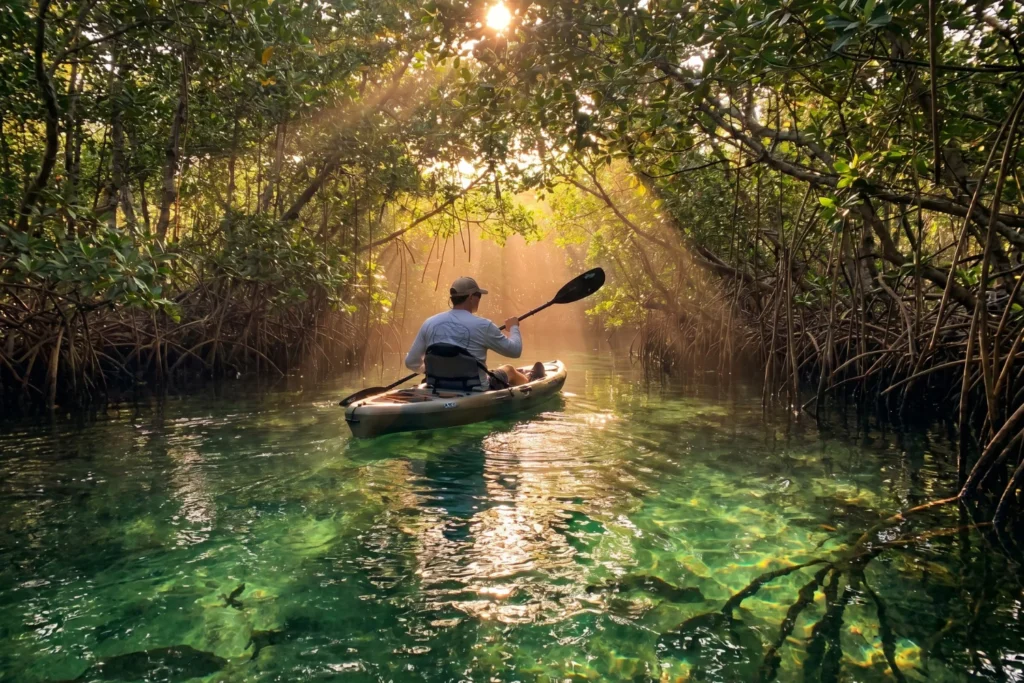
Swimming & Sunbathing (best spots):
- Siesta Key Beach — the quartz sand genuinely doesn’t get hot. You can walk barefoot at noon in July.
- Henderson Beach State Park (Panhandle) — quieter than Destin’s public beach, same sand quality, $6/vehicle entry.
- Bahia Honda State Park (Keys) — small beach but the water color is unreal. Arrive before 9 AM; the park hits capacity on winter weekends.
Shelling:
- Sanibel Island — the shelling capital of Florida. The “Sanibel Stoop” (everyone bent over searching) is real. Best after storms and at low tide, early morning.
- Caladesi Island State Park — accessible only by ferry ($16 round trip from Honeymoon Island), which keeps crowds manageable. Shells here rival Sanibel.
Snorkeling & Diving:
- Bahia Honda State Park — reef accessible from shore on calm days
- John Pennekamp Coral Reef State Park (Key Largo) — glass-bottom boat tours ($38) or self-guided snorkel trips ($30 + gear)
- Destin jetties — surprisingly good for beginners; clear water, visible fish
Kayaking & Paddleboarding:
- Weeki Wachee Springs kayak trail — not a beach, but crystal-clear spring water and possible manatee sightings (winter months)
- Fort De Soto Park (near St. Pete) — calm mangrove channels, rentals available on-site ($25/hour)
- Destin Harbor — guided sunset paddle tours ($45–$60/person)
Fishing:
- Destin Harbor half-day charters: $80–$120/person, targeting red snapper (seasonal), grouper, and amberjack
- Fort Myers Beach pier: free, no license required from the pier, catches include snook and sheepshead
- Sebastian Inlet (Atlantic): one of Florida’s best shore-fishing spots for snook and tarpon
Counter-intuitive recommendation: Visit HB City Beach for a perspective on how other coastal cities handle the beach-town balance between development and preservation — it’s an interesting contrast to Florida’s approach.
Beach volleyball: Clearwater Beach and South Beach both have permanent nets. Pickup games happen daily after 4 PM. The sand at Clearwater is deeper and softer — harder on legs but easier on dives.
A lot to choose from — so here’s a structured way to experience multiple coastlines without rushing.
5-Day Itinerary — How to Make the Most of Your Trip
For a 5-day trip to Florida beaches, the ideal itinerary covers both the Gulf Coast and one alternative area — either the Panhandle, the Keys, or the Atlantic side — using Tampa as a central base for the first three days before moving.
Day 1: Arrive Tampa → Clearwater Beach
- Morning: Pick up rental car, drive to Clearwater Beach (30 min)
- Midday: Lunch at Frenchy’s Outpost, walk Pier 60
- Afternoon: Visit Clearwater Marine Aquarium (Winter the dolphin’s former home) — $30/adult
- Evening: Sunset at Pier 60 (nightly festival with street performers)
Day 2: Siesta Key
- Morning: Drive south to Siesta Key (75 min). Arrive before 9 AM for parking.
- Midday: Set up on the main beach. Notice the sand temperature difference — noticeably cooler.
- Afternoon: Walk to Siesta Key Village for lunch and shopping
- Evening: Sunset from Point of Rocks (south end of beach) — tide pools and calmer water
Day 3: Caladesi Island + St. Pete
- Morning: Ferry from Honeymoon Island to Caladesi Island State Park ($16 round trip). Bring snacks — limited food options on the island.
- Midday: Shell hunting and swimming on an uncrowded Gulf beach
- Afternoon: Return via ferry, drive to St. Pete Beach, walk past the Don CeSar
- Evening: Dinner on Gulf Boulevard; early rest before travel day
Day 4: Drive to Panhandle (or Keys alternative)
- Option A — Panhandle (4.5 hours from Tampa): Henderson Beach State Park for the afternoon. Sugar-white sand, emerald water, minimal development.
- Option B — Keys (4 hours from Tampa): Bahia Honda State Park. Stop at Robbie’s Marina in Islamorada to hand-feed tarpon ($4 entry + $5 fish bucket).
Day 5: Final beach morning + departure
- Morning: Sunrise beach walk. One last swim.
- Midday: Pack up, drive to departure airport
- Note: If flying from a Panhandle airport (VPS or ECP), check flights — options are limited and more expensive than Tampa.
Seasonal adjustment: In summer, shift beach time to mornings (8 AM–noon) and plan indoor activities for the 2–4 PM thunderstorm window. In winter, the Panhandle water may be too cold for swimming — swap for the Keys.
If you’re exploring other best places to travel this year, Florida’s beach diversity makes it one of the most versatile domestic options.
Comparison Table: Florida Beaches at a Glance
| Beach | Coast | Sand Type | Crowd Level | Parking | Best For |
|---|---|---|---|---|---|
| Clearwater Beach | Gulf | Fine white | High | Paid garage, fills early | Families, first-timers |
| Siesta Key | Gulf | Powdery quartz | High (weekends) | Free lot, limited | Couples, sand purists |
| Henderson Beach SP | Gulf/Panhandle | Sugar-white | Low–Moderate | $6/vehicle | Solitude seekers |
| South Beach | Atlantic | Tan, coarse | Very High | Metered, expensive | Nightlife, people-watching |
| St. Augustine Beach | Atlantic | Compact tan | Moderate | Free (south end) | History lovers, budget travelers |
| Bahia Honda SP | Keys | Narrow, mixed | Moderate | $8/vehicle, capacity limits | Snorkelers, nature lovers |
| Caladesi Island SP | Gulf | Fine white | Low | Ferry access only ($16) | Shell collectors, quiet seekers |
| Cocoa Beach | Atlantic | Tan, firm | Moderate | Free–$10 | Surfers, teens, space fans |
| Fort De Soto Park | Gulf | Fine white | Moderate | $5/vehicle | Kayakers, families, campers |
| Destin / Miramar | Gulf/Panhandle | White | High (summer) | Paid, varies | Water sports, fishing |
Conclusion
Florida’s beaches reward travelers who match coastline to preference rather than chasing a single “best” list. The Gulf Coast delivers serenity and family-friendly water. The Atlantic offers energy and surf. The Keys and Panhandle are niche picks that reward effort.
This trip is not for anyone who hates driving. Florida’s beaches are spread across hundreds of miles with limited public transit, and hopping between regions requires planning and car time.
Ready to compare international beach destinations? Explore our guide to the best travel destinations in South America for a completely different coastal experience.
Explore More on ChillTraveling
- Beach town living: HB City Beach guide
- Best travel destinations in South America
- Best places to travel right now
FAQ
Q: What is the number 1 rated beach in Florida?
A: Siesta Key Beach consistently tops Dr. Beach’s annual rankings due to its 99% quartz sand that stays cool, crystal-clear water, and wide shoreline. However, “number 1” depends on criteria — Clearwater Beach wins for family amenities, and Bahia Honda wins for snorkeling. Rankings shift yearly based on water quality testing and sand composition analysis.
Q: Is the Gulf side or Atlantic side better for swimming?
A: The Gulf side is better for casual swimming — warmer water, minimal waves, and a gradual sandy bottom. The Atlantic side has stronger currents and more wave action, making it better for surfing and boogie boarding but less ideal for young children or nervous swimmers. Gulf water temperatures average 5–8°F warmer than the Atlantic from May through October.
Q: How much does a week-long Florida beach trip cost?
A: A mid-range week (two travelers, hotel, dining out, one daily activity) costs approximately $2,800–$4,200 total. Budget travelers staying in vacation rentals and cooking most meals can manage $1,400–$2,000. Luxury beachfront resorts push the total above $6,000. Parking and beach gear rentals add $150–$300/week that most people don’t budget.
Q: Are Florida beaches safe for swimming?
A: Generally yes, but rip currents cause more drownings than sharks or jellyfish. Always swim near lifeguard stations, check posted flag conditions (red = high hazard, double red = water closed), and never fight a rip current — swim parallel to shore. Jellyfish are common but rarely dangerous; Portuguese man-o’-war appear occasionally on Atlantic beaches after storms.
Q: Can you drink alcohol on Florida beaches?
A: It varies by county and city. Clearwater Beach, South Beach, and most Panhandle beaches prohibit open containers. However, some beaches (parts of St. Pete Beach, unincorporated areas) allow it. Pinellas County banned alcohol on all beaches in 2022. Check local ordinances before packing a cooler — fines range from $100–$500.
Q: When is hurricane season in Florida and should I avoid it?
A: Hurricane season runs June 1 through November 30, with peak activity in August and September. Should you avoid it entirely? Not necessarily. September offers the lowest prices and emptiest beaches, and modern forecasting provides 5+ days of warning. Travel insurance covering weather cancellation is essential for any trip during these months. October is a reasonable compromise — lower risk, still warm, still cheap.
Q: Are dogs allowed on Florida beaches?
A: Most popular Florida beaches prohibit dogs, including Clearwater, Siesta Key, and South Beach. Dog-friendly exceptions include Fort De Soto Park’s designated dog beach (off-leash allowed), Jupiter Beach (Leilani welcomes dogs year-round), and several Jacksonville-area beaches during specific hours. Always verify current pet policies — they change seasonally and enforcement varies by municipality.
Q: Do I need a car to visit Florida beaches?
A: For Gulf Coast and Panhandle beaches, yes — public transit is extremely limited. In Miami/South Beach, you can skip the car entirely using rideshares and the Metromover. Clearwater has the Jolley Trolley ($2.50/ride) connecting hotels to the beach strip. For any itinerary covering multiple beaches or coastlines, a rental car is effectively non-negotiable.